
Waterhouse VC invests globally in publicly listed and private companies across the wagering and gaming ecosystem. The Fund is available to wholesale investors only.
Since inception (August 2019), Waterhouse VC has achieved a net total return of +2,863% (61.9% p.a. annualised) as at 31 August 2026, assuming reinvestment of all distributions. Past performance is not a reliable indicator of future performance.
Betting on Autopilot
In June 1914, Lawrence Sperry flew over the Seine near Paris with both hands raised while his mechanic climbed onto the wing. A gyroscopic stabiliser kept the aircraft level. Sperry was demonstrating one of the first autopilots.
More than a century later, autopilot handles much of a commercial flight, but few passengers would board without a pilot. The crew sets the flight path, monitors the systems and takes over when needed.
Betting is heading towards its own version. A sports bettor could give an AI agent a budget and instructions to follow a cricket model, back an NFL tipster’s selections and monitor golfers throughout a tournament. The software could research selections and, where the platform permits, place bets within agreed limits, leaving the customer to get on with their day.
We expect this convenience to draw more customers into wagering and make specialist tools and betting expertise more useful to a wider audience. Prediction markets such as Polymarket already support automated trading, offering an early home for these products. Sportsbooks will face pressure to offer similar convenience within their own platforms.
A bot of your own
Automated betting is well established. Professional racing syndicates use computer-assisted wagering, combining probability models with software that places bets into tote pools at scale. Betfair also supports automated betting through its Exchange API.
AI agents could widen access to these capabilities. Customers who would never build a betting bot could describe a strategy in ordinary language and have software carry it out.
A conventional bot might take a tipster’s selections from a feed and submit bets within preset price and stake limits. An agent can work from a broader instruction, deciding which information and tools to use. For cricket, that might mean gathering team news and weather forecasts, consulting a specialist model and comparing its predictions with available odds before placing a bet.
Agents can also follow familiar strategies, such as betting on price momentum or a reversal after a sharp move. They can make markets by quoting buying and selling prices to try to earn the spread. Exchanges have reason to welcome this activity. Market-making bots can improve liquidity, making it easier for other customers to trade, while additional fee-paying trades increase revenue.
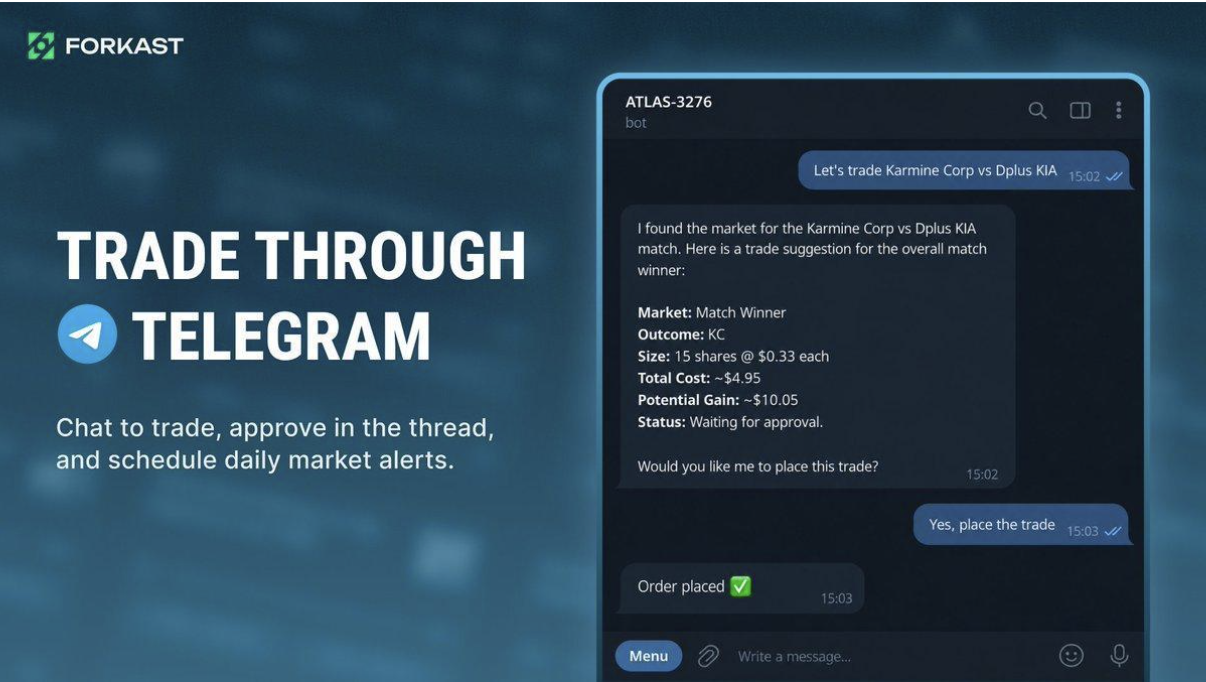
Consumer products are already live. AI agent platform Olas launched Polystrat in February. Users fund an agent and choose or describe a strategy; the software then evaluates markets and trades on Polymarket. Forkast’s ATLAS lets customers request and approve trades through Telegram.
Forkast’s ATLAS proposes a trade and asks for the customer’s approval through Telegram. Source: Forkast.
Hands off the controls
The “trade while you sleep” pitch is already visible on X. Providers and promoters have reason to publicise profitable trades: screenshots can sell subscriptions. As with Sperry, the demonstration helps sell the technology. However, a profitable trade says little about lasting returns.
Polymarket’s public trading records let curious bettors investigate which accounts are making money, what they trade and whether the approach could be followed. As the tools get easier to use, bettors can copy accounts, adapt strategies and test ideas that once required a developer. Some may build tools for themselves and find others willing to pay.
Earning trust
An immediate benefit for bettors is consistent execution. A recreational bettor who likes a selection might treat a $25 bet at $2.20 much like one at $2.50. Yet if the selection has a 43% chance of winning, $2.20 implies an expected loss of 5.4 cents per dollar staked; $2.50 implies an expected profit of 7.5 cents, before fees.
Given a probability estimate and staking rules, software can calculate stakes as prices change and decline bets below a minimum price. It can also enforce agreed staking and spending limits, helping customers manage their bankroll. That consistency and the time saved may be worth paying for, but automation cannot make a poor strategy profitable.
The customer still sets the flight path. Letting an agent choose bets requires more confidence than asking it to follow instructions, and customers may want to approve individual trades before granting more discretion.
One contact in our network uses a Telegram bot to identify bets and calculate stakes under Australian racing’s minimum bet rules. These require bookmakers to accept qualifying bets up to a specified potential win. The bot calculates the stake quickly, helping him act before the price moves. He still approves each bet before it is placed.
Professional betting teams will scrutinise execution, error handling and the protection of their strategies. Any tool they adopt must preserve the advantage they have spent years building.
A crowded trade
If many agents pursue the same bets, their orders can move prices against later customers. Bill Benter described a similar problem in horse racing: independently developed models could favour the same horses, reducing payouts for everyone backing them.
Copying a successful account’s selections is also easier than reproducing its returns. Positions spread across several accounts can leave followers with an incomplete picture, while a worse entry price can erase the original edge. An agent still needs to judge whether a bet offers value at the price its customer can obtain.
The opportunity
As more agents compete for the same opportunities, we believe proprietary data, original analysis and specialist betting expertise will become more valuable. Agents could also expand the audience for tipsters by acting on selections that customers would otherwise miss, provided they can still obtain prices that preserve the advantage.
As customers expect more useful, personalised tools, wagering operators will need to decide what to build and what to buy.
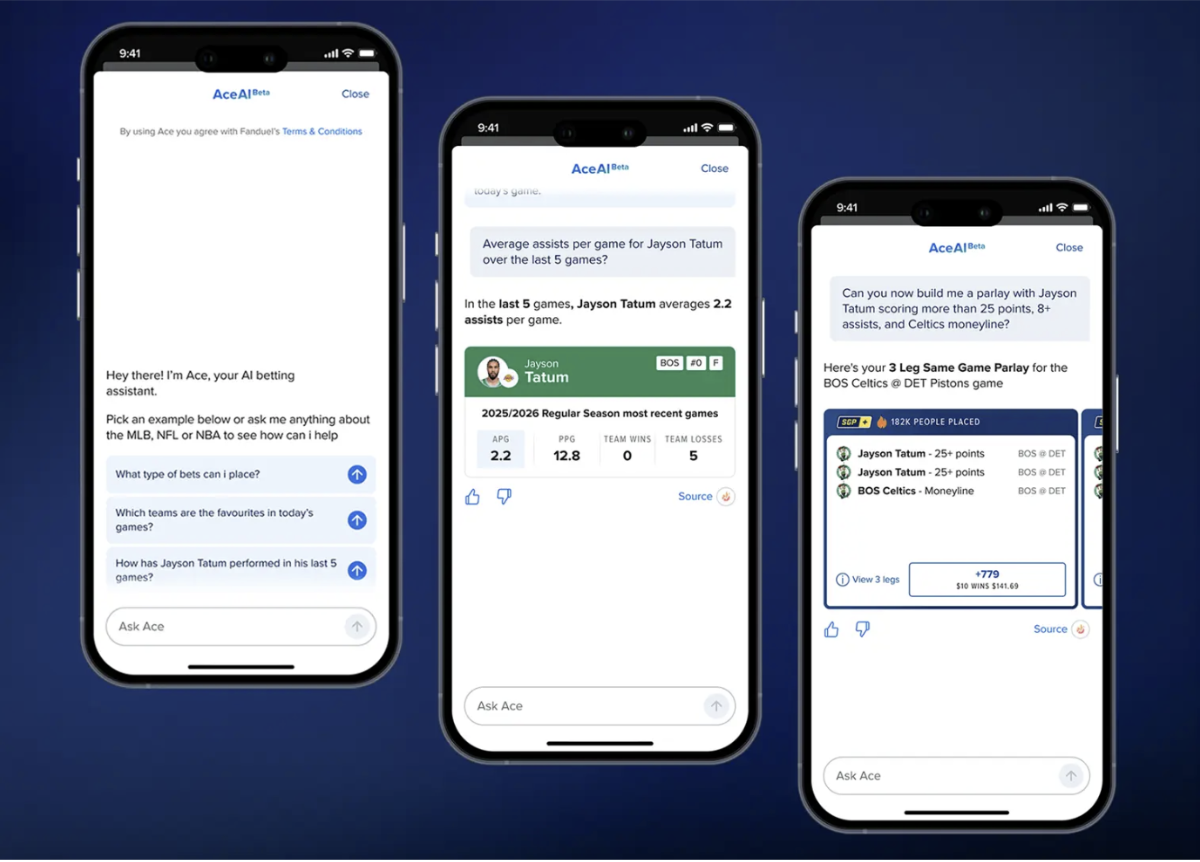
FanDuel’s AceAI lets customers research markets and build bets through conversation. Customers still place their own bets. Source: FanDuel.
FanDuel developed AceAI internally, then shared code and infrastructure with fellow Flutter brand Sportsbet for its equivalent assistant. Large groups can spread that investment across their own brands.
Specialist suppliers can spread development and maintenance costs across multiple operators. Combined with proprietary data or betting expertise that is difficult to reproduce, this can give operators a compelling reason to buy.
For Waterhouse VC, the opportunity is to back suppliers that deliver better products at a lower cost than operators could achieve in-house.
Pitch Us
If you know any gambling tech companies seeking capital or distribution support, our 'Pitch' page makes it simple to connect with our investment team.
Media
Tom Waterhouse recently sat down with Gaming News Canada to discuss how AI and regulation are reshaping sports betting and iGaming, the shifting sands of regulated gambling jurisdictions, prediction markets, and more.
For wholesale investors interested in following wagering and gaming industry news and trends, please follow our updates on X (@waterhousevc) and WaterhouseVC.com.
DISCLAIMER AND IMPORTANT NOTES
Performance shown is net of fees and expenses and assumes the reinvestment of all distributions on July 1 each year. We make every endeavour to ensure results are accurate. The results are indicative only and subject to subsequent year end external financial review. Past performance is not a reliable indicator of future performance.
Please note the above information in relation to OpenAI, Betfair, Polymarket, Olas (Polystrat), Forkast (ATLAS), Telegram, X, Bill Benter and FanDuel (AceAI) is based on publicly available information and should not be considered nor construed as financial product advice. The information provided in this document is general information only and does not constitute investment or other advice. Readers should consult and rely on professional investment advice specific to their individual circumstances.
Not for Release or Distribution in the United States of America
This material may not be released or distributed in the United States. This material does not constitute an offer to sell, or a solicitation of an offer to buy, any securities in the United States or any other jurisdiction in which such an offer would be illegal. The units in the Fund have not been, and will not be, registered under the U.S. Securities Act of 1933, as amended (the U.S. Securities Act) or the securities laws of any state or other jurisdiction of the United States. Accordingly, the units in the Fund may not be offered or sold in the United States unless they are offered and sold, directly or indirectly, in transactions exempt from, or not subject to, the registration requirements of the U.S. Securities Act and any other applicable United States state securities laws.
General Information Only
This material is for general information only and is not an offer for the purchase or sale of any financial product or service. The material has been prepared for investors who qualify as wholesale clients under sections 761G of the Corporations Act or to any other person who is not required to be given a regulated disclosure document under the Corporations Act. The material is not intended to provide you with financial or tax advice and does not take into account your objectives, financial situation or needs. Although we believe that the material is correct, no warranty of accuracy, reliability or completeness is given, except for liability under statute which cannot be excluded. Please note that past performance may not be indicative of future performance and that no guarantee of performance, the return of capital or a particular rate of return is given by Sandford Capital, Waterhouse VC or any other person. To the maximum extent possible, Sandford Capital, Waterhouse VC or any other person do not accept any liability for any statement in this material.
Financial Regulatory Oversight and Administration
Waterhouse VC is an Australian Unit Trust denominated in AUD and available to wholesale institutional investors worldwide with a minimum of AUD 500,000 or USD / EUR / GBP / JPY / CHF equivalent. This material has been prepared by Waterhouse VC Pty Ltd (ABN 48 635 494 861) (‘Waterhouse VC’, ‘Trustee’, ‘us’ or ‘we’) as the Trustee of the Waterhouse VC Fund (the ‘Fund’). The Trustee is a corporate authorised representative (CAR 1278656) of Sandford Capital Pty Limited (ABN 82 600 590 887) (AFSL 461981) (Sandford Capital) and appoints Sandford Capital as its AFS licensed intermediary under s911A(2)(b) of the Corporations Act 2001 (Cth) to arrange for the offer to issue, vary or dispose of units in the Fund.
Performance
Past performance of Waterhouse VC is not a reliable indicator of future performance. We make every endeavour to ensure results are accurate. Waterhouse VC Pty Ltd does not guarantee the performance of any strategy or the return of an investor’s capital or any specific rate of return. No allowance has been made for taxation, where applicable. We encourage you to think of investing as a long-term pursuit. Waterhouse VC’s results are indicative only and subject to subsequent year end external financial review.
Copyright
Copyright © Waterhouse VC Pty Ltd ACN 635 494 861. No part of this message, or its content, may be reproduced in any form without the prior consent of Waterhouse VC.
Governing Law
These Terms and Conditions of use are governed by and are to be construed in accordance with the laws of New South Wales. By accepting these Terms and Conditions of use, you agree to the non-exclusive jurisdiction of the courts of New South Wales, Australia in respect of any proceedings concerning these Terms and Conditions of use.