
Waterhouse VC invests globally in publicly listed and private companies across the wagering and gaming ecosystem. The Fund is available to wholesale investors only.
Since inception (August 2019), Waterhouse VC has achieved a gross total return of +3,653% (75% p.a. annualised) as at 31 January 2026, assuming reinvestment of all distributions.
Unstoppable Force
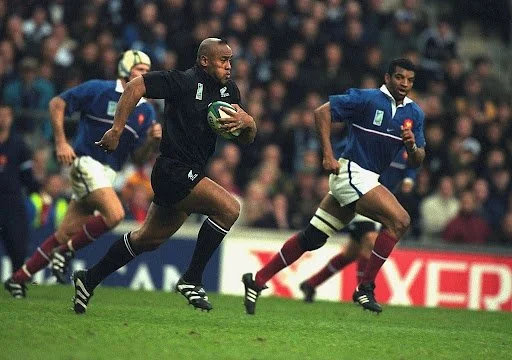
New Zealand gave the world Jonah Lomu. When he hit full stride, he was almost impossible to stop. The country’s gambling market has met a similar force. Customers bypassing domestic channels for offshore sites that sit beyond regulatory reach. Once it gets going, enforcement struggles to make a tackle.
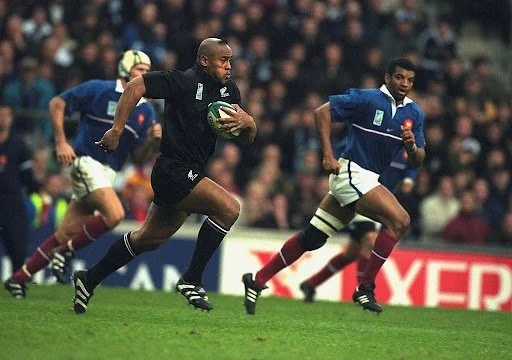
Jonah Lomu in full flight against France. Source: Dave Rogers / Allsport via Getty Images
If people want access to something online, supply will find them. The most credible counter to offshore leakage is giving the regulated market the conditions to compete. For APAC, New Zealand is shaping up as the test case. Five million people, high disposable income, near-universal internet penetration, and estimates of up to NZ$800 million already flowing offshore annually. For Waterhouse VC, it is a signal of opportunity. If they get it right, others will pay attention.
Grey vs All Black
New Zealand's legal gambling market spans sports and racing through TAB NZ, lotteries through Lotto NZ, five land-based casinos, and roughly 14,500 pokie machines in pubs and clubs. Legal online casino is the gap. It has been legal for New Zealanders to gamble on offshore sites for two decades, but illegal to operate one domestically or advertise in the country. Customers still find them.
Recent media scrutiny highlights younger generations, particularly university students, engaging with these sites. In July 2025, the Department of Internal Affairs (DIA) warned 10 students for promoting them for financial gain. The pipeline from casual user to paid affiliate is shortening, and without comprehensive regulation, intervention options remain limited.

NZ media coverage of offshore online casino use among students. Source: stuff.co.nz
The government now has hard numbers. A 12% Offshore Gambling Duty has applied since July 2024 to offshore operators serving New Zealand residents, excluding sports and racing betting. The duty is levied on ‘offshore gambling profits’ - effectively GGR, (stakes minus winnings, before tax and costs). In the 12 months to 30 June 2025, operators declared NZ$520.8 million of liable GGR, paying NZ$62.5 million in duty. Only twenty-six entities were registered, and the top five accounted for 89.6% of liable revenue.
That is roughly NZ$10 million a week in player losses flowing offshore, and almost certainly an undercount. Duty returns capture the compliant slice of the market. The duty behaves like an honesty tax, paid by the largest and most visible firms while the rest ignore it.
In Australia, where online casino and live in-play betting are banned, the illegal offshore market reached A$3.9 billion in 2024 and is tracking toward A$5 billion by 2029 (Responsible Wagering Australia). Offshore operators now account for 36% of all online gambling, the onshore channelisation rate has fallen from 74% to 64% in three years, and half of those gambling offshore have done so while registered on BetStop, the national self-exclusion system (Australia Offshore Market Analysis 2025, Responsible Wagering Australia). Whether grey or black is the label, the dynamic is the same.
The Great Wall
Even China can’t stop it. Gambling is banned and the internet is controlled, yet in 2024 China’s Ministry of Public Security said it dismantled more than 4,500 illegal online gambling platforms.
Despite heavy enforcement, the market remains fluid: domains rotate, payments reroute, and consumers bypass blocks with proxies and VPNs. The United Nations Office on Drugs and Crime (UNODC) puts the global illegal betting market at up to US$1.7 trillion wagered annually. It is a whack-a-mole where the moles multiply faster than the hammer can swing. If even China can’t contain it, that says plenty about the limits of enforcement alone.
That leaves governments with three options. Ignore it, letting tax revenue and consumer protections drain offshore. Fight it, spending more each year on enforcement that to date, has struggled to keep pace. Or face it, and build a legal market compelling enough that customers choose it voluntarily. New Zealand is signalling it wants door three, with enabling legislation now moving through Parliament.
The Channelisation Aim
“My hope is that Kiwis will gamble in a safer regulated market than we currently have, with harm minimisation standards and we will have consumer protection standards”
Brooke van Velden, Internal Affairs Minister
The scope remains narrow, focusing exclusively on online casinos. Lotteries will remain under the jurisdiction of the Lotteries Commission, land-based casinos under existing law, and sports and racing betting exclusively with TAB NZ. That exclusivity was cemented in June 2025, when amendments to the Racing Industry Act banned all other operators from offering online sports or racing betting into New Zealand on an extraterritorial basis.
TAB NZ, operated by Entain under a 25-year partnership, delivered an estimated NZ$200 million to the racing codes in FY23/24, yet an estimated NZ$180 million a year was still flowing offshore prior to the ban. The casino reform does not target that leakage directly. But offshore operators run full-service platforms. A customer who goes offshore for slots is one click from an integrated sportsbook. Win back casino play and you shrink the entire offshore ecosystem.
The Framework
The Online Casino Gambling Bill was introduced on 30 June 2025, passed its first reading on 15 July, and is awaiting its second reading. The Act is expected to commence on 1 May 2026, triggering a ban on advertising by unlicensed operators and lifting penalties. Under the indicative timeline, Fifteen licences, capped at three per operator, will be allocated in three stages: expressions of interest in July 2026, auction in September, applications from October. From 1 December 2026, operators must have applied for a licence or exit the market. Applicants can continue operating until a decision is reached, or 1 June 2027 at the latest. The regime reaches offshore with fines up to NZ$300,000 for individuals and NZ$5 million for corporates, additional take-down powers, and the ability to pursue unlicensed operators regardless of jurisdiction.
The strongest opposition came from community organisations concerned online casinos would cannibalise pokies revenue. Pokie operators must return at least 40% of gross profits to community purposes, roughly NZ$300 million a year. The government responded by lifting the offshore gambling duty from 12% to 16% from January 2027, with the additional 4% ring-fenced for community returns.
Consumer protections include identity verification, spending limits, self-exclusion, a credit card deposit ban, advertising restrictions, and bonus controls.
Goldilocks
Regulation can boost state coffers, but it does not guarantee channelisation. Jarden forecast annual gross betting revenue of NZ$650 million assuming all 15 licences are issued, with NZ$474.5 million in net revenue after a 27% tax burden (including GST). That estimate preceded the government's confirmation of the additional 4% community levy.
Ontario, Canada shows what a competitive legal offer can achieve. Three years after opening its regulated iGaming market in April 2022, 83.7% of respondents who had gambled online in the past three months reported wagering on regulated sites (Ipsos survey for iGaming Ontario and AGCO, fieldwork 30 January to 19 February 2025). The province has generated CAD$2.04 billion in tax revenue since launch.
The UK shows what happens when friction accumulates. Financial risk checks have already weighed on licensed operators, and that is before remote gaming duty increases from 21% to 40% in April 2026.
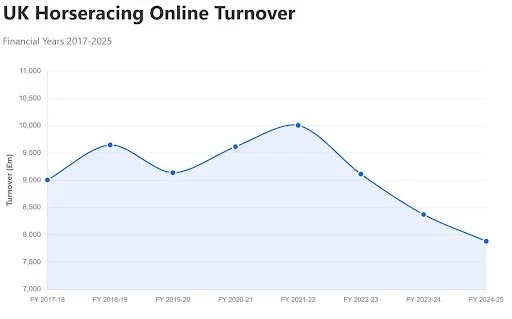
UK horseracing online betting turnover is in decline. Source: UK Gambling Commission (via Paul Fitzgerald on X)
If New Zealand gets the balance right, it becomes the blueprint for the region.
Opportunity
New Zealand's direction is built on a realistic constraint - enforcement alone cannot keep pace with an internet-native market. The sustainable lever is making the legal market the default by being safer, simpler, and good enough that most customers stay.
When a market turns toward regulation, demand becomes recurring for the infrastructure that makes compliance and trust possible. That is where Waterhouse VC specialises. We are actively scouting businesses positioned to serve the eventual New Zealand licence winners and, if the model proves successful, the broader wave of APAC markets that may follow.
Pitch Us
If you know any gambling tech companies seeking capital or distribution support, our 'Pitch' page makes it simple to connect with our investment team.
Media
Tom joined Ausbiz to speak about NZ legalising online casinos to ‘claw back’ the offshore gambling revenue, as well as the supplier opportunities we’ll be targeting in this market.
For wholesale investors interested in following wagering and gaming industry news and trends, please follow our updates on Twitter (@waterhousevc) and WaterhouseVC.com.
DISCLAIMER AND IMPORTANT NOTES
Performance shown is before all fees and expenses and assumes the reinvestment of all distributions on July 1. We make every endeavour to ensure results are accurate. The results are indicative only and subject to subsequent year end external financial review. Past performance is not a reliable indicator of future performance.
Please note the above information in relation to TAB NZ, New Zealand Department of Internal Affairs, Lotto NZ, Stuff, and Entain is based on publicly available information and should not be considered nor construed as financial product advice. The information provided in this document is general information only and does not constitute investment or other advice. Readers should consult and rely on professional investment advice specific to their individual circumstances.
Not for Release or Distribution in the United States of America
This material may not be released or distributed in the United States. This material does not constitute an offer to sell, or a solicitation of an offer to buy, any securities in the United States or any other jurisdiction in which such an offer would be illegal. The units in the Fund have not been, and will not be, registered under the U.S. Securities Act of 1933, as amended (the U.S. Securities Act) or the securities laws of any state or other jurisdiction of the United States. Accordingly, the units in the Fund may not be offered or sold in the United States unless they are offered and sold, directly or indirectly, in transactions exempt from, or not subject to, the registration requirements of the U.S. Securities Act and any other applicable United States state securities laws.
General Information Only
This material is for general information only and is not an offer for the purchase or sale of any financial product or service. The material has been prepared for investors who qualify as wholesale clients under sections 761G of the Corporations Act or to any other person who is not required to be given a regulated disclosure document under the Corporations Act. The material is not intended to provide you with financial or tax advice and does not take into account your objectives, financial situation or needs. Although we believe that the material is correct, no warranty of accuracy, reliability or completeness is given, except for liability under statute which cannot be excluded. Please note that past performance may not be indicative of future performance and that no guarantee of performance, the return of capital or a particular rate of return is given by Sandford Capital, Waterhouse VC or any other person. To the maximum extent possible, Sandford Capital, Waterhouse VC or any other person do not accept any liability for any statement in this material.
Financial Regulatory Oversight and Administration
Waterhouse VC is an Australian Unit Trust denominated in AUD and available to wholesale institutional investors worldwide with a minimum of AUD 500,000 or USD / EUR / GBP / JPY / CHF equivalent. This material has been prepared by Waterhouse VC Pty Ltd (ABN 48 635 494 861) (‘Waterhouse VC’, ‘Trustee’, ‘us’ or ‘we’) as the Trustee of the Waterhouse VC Fund (the ‘Fund’). The Trustee is a corporate authorised representative (CAR 1278656) of Sandford Capital Pty Limited (ABN 82 600 590 887) (AFSL 461981) (Sandford Capital) and appoints Sandford Capital as its AFS licensed intermediary under s911A(2)(b) of the Corporations Act 2001 (Cth) to arrange for the offer to issue, vary or dispose of units in the Fund.
Performance
Past performance of Waterhouse VC is not a reliable indicator of future performance. We make every endeavour to ensure results are accurate. Waterhouse VC Pty Ltd does not guarantee the performance of any strategy or the return of an investor’s capital or any specific rate of return. No allowance has been made for taxation, where applicable. We encourage you to think of investing as a long-term pursuit. Waterhouse VC’s results are indicative only and subject to subsequent year end external financial review.
Copyright
Copyright © Waterhouse VC Pty Ltd ACN 635 494 861. No part of this message, or its content, may be reproduced in any form without the prior consent of Waterhouse VC.
Governing Law
These Terms and Conditions of use are governed by and are to be construed in accordance with the laws of New South Wales. By accepting these Terms and Conditions of use, you agree to the non-exclusive jurisdiction of the courts of New South Wales, Australia in respect of any proceedings concerning these Terms and Conditions of use.